
Pulsed LASER CLEANING
unlimited possibilities
P-Laser – Engineering Solutions for Industrial Cleaning Challenges
P-Laser is an engineering company dedicated to solving our customers' cleaning and surface preparation challenges. While some applications fit within our standard solutions—such as mold cleaning, surface cleaning, and weld cleaning—many customer requirements are unique. This is where we make the difference.
Our approach starts with pre-production testing to validate the process and optimize the parameters. We work closely with our customers until we deliver a fully validated solution that is ready for integration into their production environment.
At the core of our systems are infrared pulsed fiber lasers. These industrial-grade laser sources are designed for maximum reliability, requiring virtually no maintenance while providing stable, trouble-free operation throughout their lifetime.
Available Laser Wavelengths
At P-Laser, we select the most suitable laser wavelength according to the material, process, and desired result. Each wavelength interacts differently with matter, making it ideal for specific industrial applications.
2940 nm Er Solid-State Laser (Mid-Infrared)
The 2940 nm Er laser is strongly absorbed by water, making it ideal for processing water-containing materials. This unique interaction enables precise and controlled material removal with minimal thermal damage.
Typical applications include:
- Medical skin resurfacing and tissue ablation
- Biofilm removal and sterilization
- Restoration and conservation of sensitive materials
- Scientific and research applications
- Selected LiDAR and sensing applications
As this wavelength is absorbed by the cornea rather than reaching the retina, the eye hazards differ from those of near-infrared lasers. Nevertheless, appropriate laser safety measures and eye protection remain essential.
1064 nm Pulsed Fiber Laser (Near-Infrared)
The pulsed 1064 nm fiber laser is the workhorse of industrial laser surface treatment. Its high peak power and short pulse duration allow precise material ablation with minimal heat input.
Typical applications include:
- Surface cleaning
- Rust and oxide removal
- Paint and coating removal
- Mold cleaning
- Weld cleaning
- Surface texturing and structuring
- Surface preparation before bonding or coating
- Marking and engraving
Suitable for both metallic and selected non-metallic materials.
1064 nm Continuous Wave (CW) Fiber Laser
Continuous-wave fiber lasers deliver a constant laser beam and are primarily used in high-speed industrial processes.
Combined with polygon scanners, they are ideal for:
- Continuous removal of grease and oil
- Removal of light oxide layers
- Cleaning continuously moving production lines
- High-speed thermal processing
532 nm Pulsed Green Laser
Green lasers offer excellent absorption in highly reflective metals such as copper, brass, silver, and gold, where infrared lasers are less efficient.
Typical applications include:
- Precision welding
- Micro-machining
- Surface structuring
- Processing electronic components
- Restoration of delicate historical objects and artworks
450 nm Continuous Wave Blue Solid-State Laser
Blue lasers provide exceptional absorption in copper and other highly reflective metals, making them ideal for applications where infrared wavelengths are less effective.
Typical applications include:
- Copper and gold welding
- Battery manufacturing
- Electronics production
- Weed control using laser technology
- Biofilm removal
- Specialized industrial processing
By combining multiple laser wavelengths and technologies, P-Laser can engineer the optimum solution for virtually any industrial surface treatment or precision processing application.
Pulsed or Continuous Wave? Fiber or Solid-State (YAG)?
Selecting the right laser technology depends entirely on the application. At P-Laser, we choose the laser source based on the required process, material interaction, and production requirements—not simply on laser power.
Pulsed vs. Continuous Wave (CW)
A pulsed laser delivers extremely high peak power during very short pulses, typically reaching peak powers of 10 to 50 kW, while the average power remains relatively low. This high peak energy enables material ablation with minimal heat transfer to the surrounding material.
Pulsed lasers are therefore the preferred choice for:
- Precision cleaning
- Paint, oxide, and coating removal
- Surface texturing and structuring
- Creating controlled and repeatable surface roughness
- High-precision marking and engraving
These applications cannot be achieved with the same precision using a continuous-wave laser.
A Continuous Wave (CW) laser emits a constant beam with lower peak power but higher continuous energy input. CW lasers are ideal for applications where material is processed continuously, such as:
- High-speed production lines
- Degreasing and removal of light oxide layers
- Welding
- Continuous thermal processing
Fiber Laser or Solid-State YAG?
For industrial applications, fiber lasers are our preferred solution. They are compact, highly efficient, require virtually no maintenance, and do not need periodic optical alignment or annual calibration. Their excellent beam quality, long lifetime, and outstanding reliability make them the ideal choice for demanding industrial environments.
Another major advantage of fiber lasers is their excellent pulse control. Parameters such as pulse duration, pulse energy, and repetition rate can be adjusted independently, allowing the laser process to be optimized for each specific application. This level of control is essential for precision surface cleaning and advanced surface structuring.
Solid-state YAG lasers still play an important role in specialized applications. Certain wavelengths—such as the 2940 nm Er laser—are currently only available using solid-state technology and offer unique material interactions that cannot yet be achieved with fiber laser sources. Er lasers are therefore indispensable for applications involving water-rich materials, medical technology, conservation, and certain restoration processes.
Many research laboratories and universities continue to use solid-state YAG lasers because of their flexibility and availability for scientific experimentation. However, for most industrial production environments, fiber laser technology provides superior reliability, lower maintenance costs, and better process stability.
By combining both fiber and solid-state laser technologies, P-Laser can always select the most suitable laser source for the application, ensuring the highest process quality and the lowest total cost of ownership.
Mili -,micro-,nano -,femto -,pico second lasers?
In the case of pulsed lasers the time delay in which a quantity of energy is delivered is important. Example ; a 1 mJ puls at 100 ns (nano seconds 10^-9) is delivering 10 KW of peak power when reaching the surface and when the totally amount of energy is absorbed. If we go to 10ns it's becoming 100 KW. More important then the peak power is the time frame of energy delivery on the surface and the resulting thermal impact.
Nano second lasers can still have thermal impact on metals like stainless steel and provoking oxidation colors from yellow to blue.
To avoid this a shorter puls duration is needed. A femto second laser is already a industrial grade tool generating Mhz (mega hertz) puls trains with very low puls energy in the range of mili-micro joules. So we can still generate a 10KW peak energy but with nearly no thermal impact. Special surface structuring to get functional surfaces can be produced with these lasers. Also producing nano particles of special elements can generate new micro granulates to be used in batteries to obtain faster charging times.
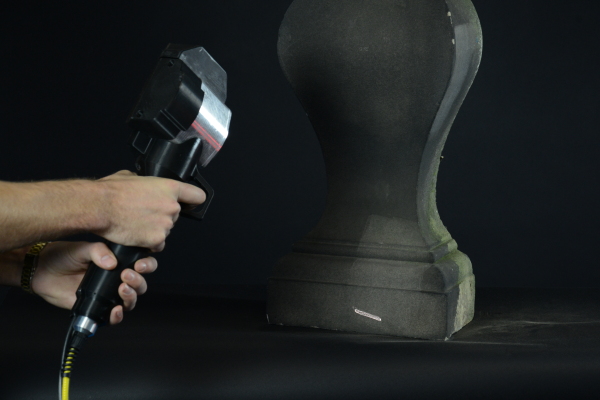
SURFACE CLEANING
Industrial surface cleaning is probably the best known laser treatment application. Rust and paint removal, degreasing, activation, restoration, etc. are all considered as surface cleaning applications.
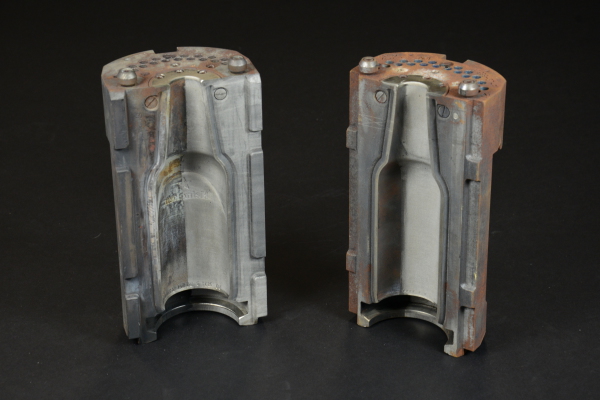
MOULD CLEANING
As they leave no blast media residue or disposal, both our Low and High Power laser equipment are the optimal solution for cleaning moulds used for rubber, plastic, glass and composite products.
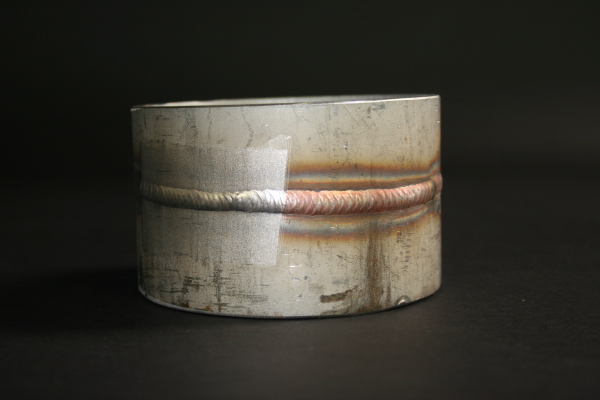
WELD CLEANING
Weld cleaning is definitely one of those classic applications of industrial laser cleaning.
It can be applied on steel, stainless steel and aluminium welds without damaging the substrate.
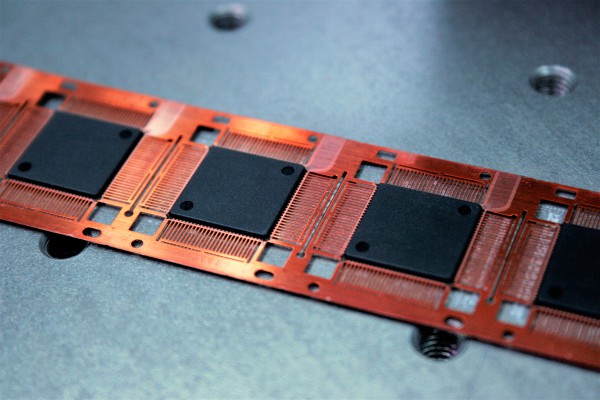
MARKING
Did you know that the working principle of marking or labeling is exactly the same as for laser cleaning?
P-Laser's Low Power systems are ideal for all your marking applications.
WHAT ABOUT YOUR APPLICATION?
It doesn't stop here! Our innovative laser cleaning technology can be used on countless
applications. Wondering if yours is applicable too? Contact us and we will be happy to help!
Get in touch with p-laser experts
contact